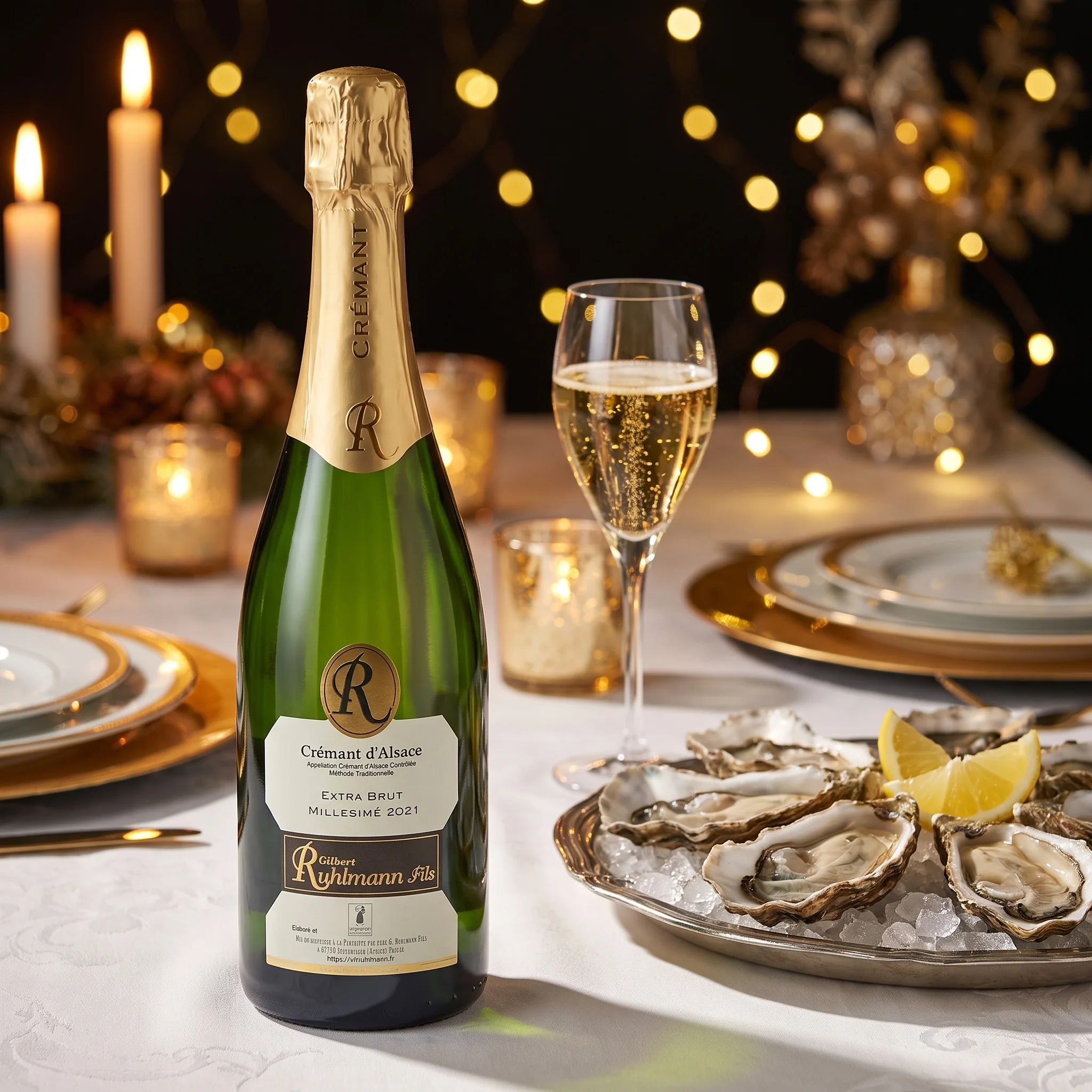
A seafood platter at Christmas, a basket of oysters for New Year’s Eve: in December, the taste of the sea comes to the table. And with it, the question of wine. Rest assured, it is one of the simplest pairings there is, as long as you follow one rule: freshness, tension and no sugar. Alsace may be far from the sea, but its dry whites and crémants are made for it. Here is how to choose, from oysters to lobster, by way of smoked salmon and scallops.
The essentials in 30 seconds
- Oysters: a dry Riesling with a saline finish, such as our Rittersberg Riesling, or an extra-brut crémant such as the Crémant Extra-Brut.
- The seafood platter: the Riesling Scherwiller, fresh and crisp, which goes with the whole platter.
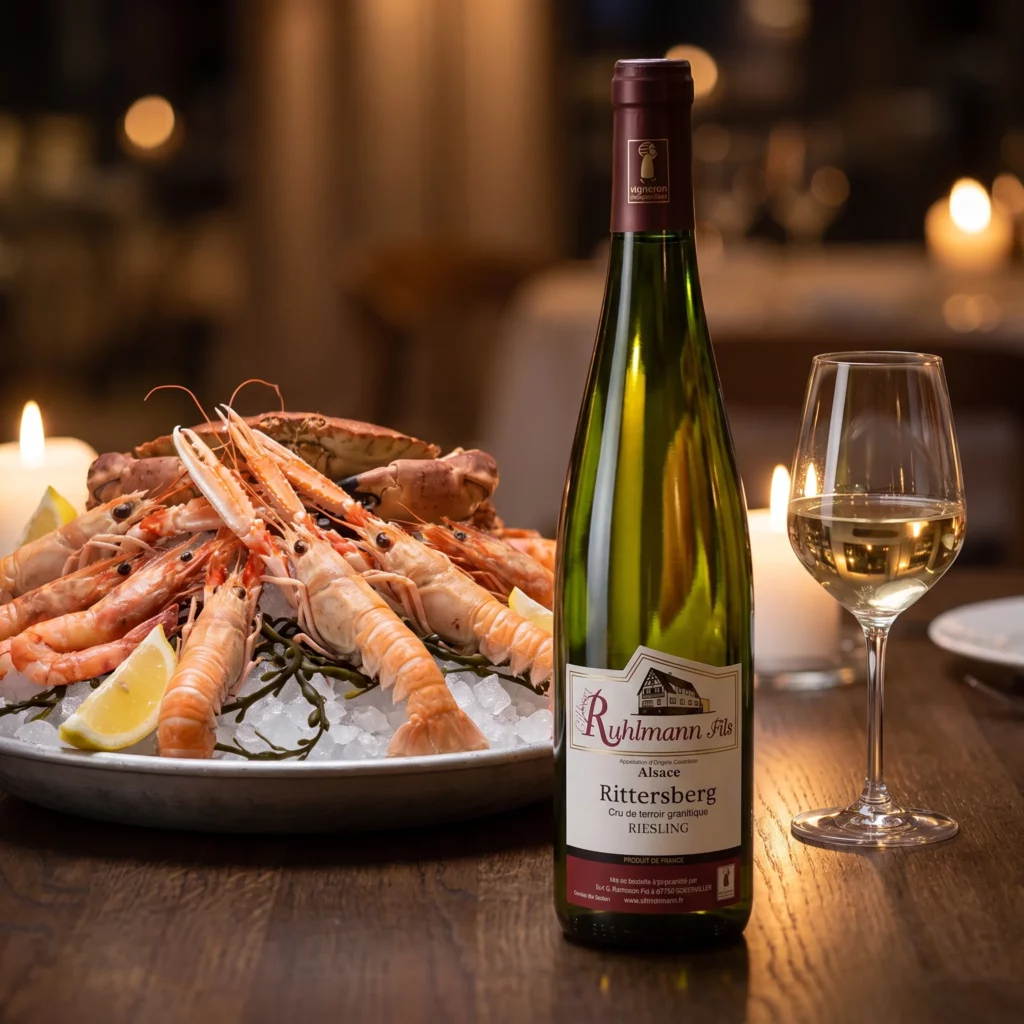
- Lobster, langoustines, crab: a fuller wine, such as the Riesling Vieilles Vignes.
- Smoked salmon: the Crémant Rosé d’Alsace.
- To avoid: tannic red wines and sweet wines with raw oysters.
The golden rule: acidity, salt, no sugar
Oysters and shellfish taste of iodine and salt, sometimes with a touch of sweetness in the fleshier ones. The right wine needs acidity, to refresh the palate between two oysters, and ideally a saline finish that echoes the sea. Sugar, on the other hand, does not get on with the salt of the sea: a sweet wine with a raw oyster is rarely a good idea.
And red wine? With oysters, better forget it. Its tannins react with the iodine and leave a metallic taste in the mouth. Keep it for the main course.
This is why our Alsace wines are so at ease with seafood. Riesling, Sylvaner, crémant: taut, dry, lively wines. Exactly the profile you need.
With oysters: our Scherwiller Rieslings
Rittersberg Riesling: granite and salt
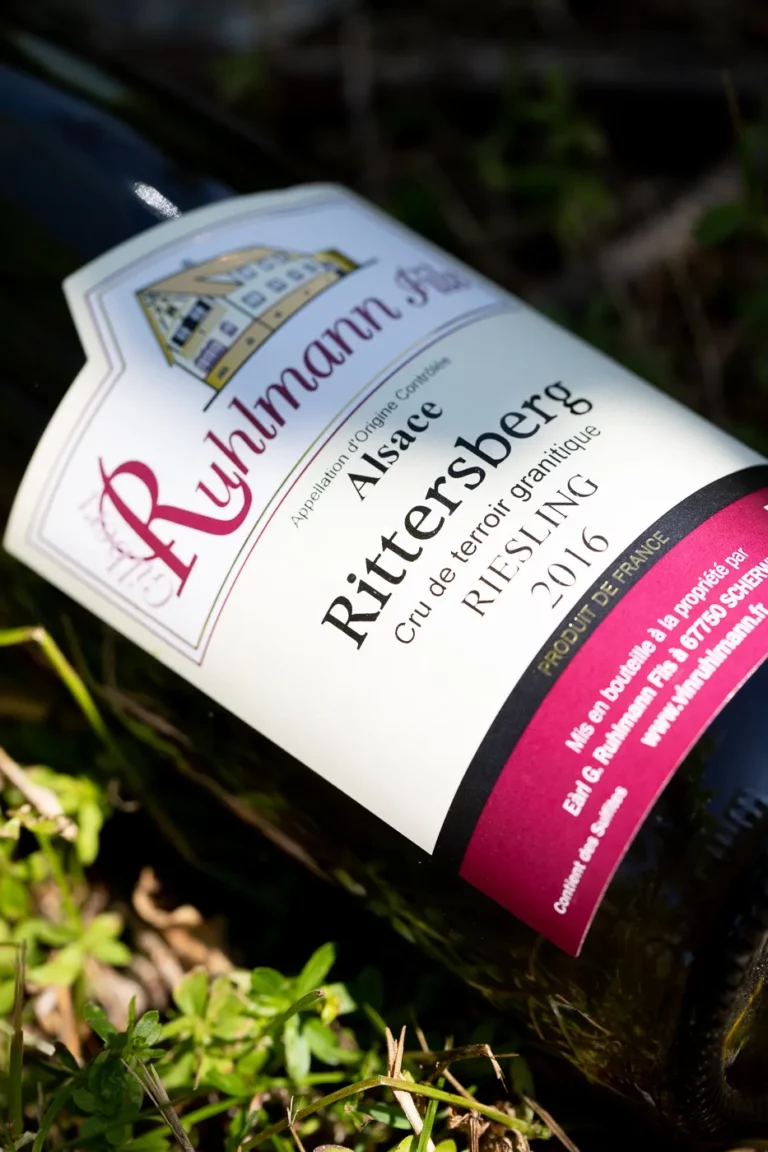
For oysters, our first recommendation is the Rittersberg Riesling. It comes from a lieu-dit in Scherwiller, at the foot of Ortenbourg Castle, on a slope facing south-south-east. The soil is a crumbly two-mica granite lying on the bedrock, and it gives taut, straight Rieslings with a saline finish. On the nose, acacia blossom and mineral notes. On the palate, a fresh attack and real structure. With an oyster, that saline finish works wonders, and the wine has enough body to follow if the platter goes on with langoustines.
Riesling Scherwiller: the most versatile
The Riesling Scherwiller bears the name of our village, and for good reason: Scherwiller is one of the communal appellations of Alsace reserved for Riesling. Its 25 to 35 year old vines grow on the gravel and sand of the alluvial fan, south-east of the village. The wine is fresh and crisp, with citrus and yellow fruit and a lemony finish. It goes with oysters, of course, but also with everything else: prawns, whelks, langoustines. It is the bottle to put in the middle of the table when the platter is well filled.
Sylvaner Vieilles Vignes: the clever choice
It is often forgotten, which is a shame. Our Sylvaner Vieilles Vignes comes from vines over 50 years old. It is a dry, light and fresh white wine with discreet floral notes. With delicate oysters or simple shellfish, it does the job very naturally. And it is one of the most affordable wines in our cellar, which helps when you have a lot of guests.
The winemaker’s tip
Mignonette, the shallot vinegar poured over oysters, is delicious, but it overwhelms the wine. If you have opened a good bottle, taste the first oysters plain, or with just a squeeze of lemon. You will appreciate the pairing much more.
Bubbles: crémant, the other oyster pairing
Crémant d’Alsace has everything oysters like: freshness, fine bubbles and an acidity that cleanses the palate. For a festive dinner, it is also the most celebratory choice.
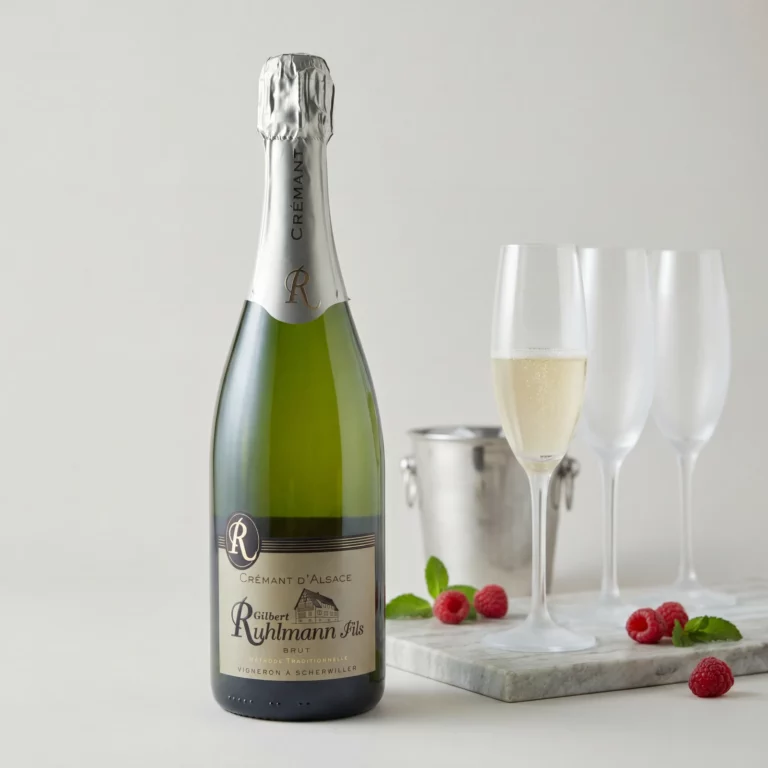
The Crémant Extra-Brut is our choice for oysters. It is even less sweet than a brut crémant, with notes of brioche, white flowers and toast. The attack is clean, the palate fresh and complex, with a lovely length. It also goes very well with lobster, langoustines and delicate fish.
Our brut Crémant d’Alsace, more floral, with white flowers and peach, is perfect if the oysters are served as an aperitif, standing up, before sitting down at the table.
Lobster, langoustines, crab: a wine with more depth
Shellfish have richer, sweeter flesh than oysters. Served hot, with mayonnaise or a butter sauce, they call for a wine with a little more roundness.
The Riesling Vieilles Vignes is made for them. It comes from our Riesling plots over 50 years old. It is a medium-dry wine (14 g/l of residual sugar), full, with lemon, pepper and sage, and an acidity that keeps it fresh. With langoustines, lobster, crab or fish in a creamy sauce, that touch of sweetness brings out the sweetness of the flesh.
For the more adventurous, try a seared langoustine with our Riesling Vendanges Tardives. It is a surprising pairing, sweet and briny at the same time, and one we often recommend for this wine.
Smoked salmon and scallops: the other festive starters
Smoked salmon needs freshness and a little fruit to answer its smoky, rich side. Our Crémant Rosé d’Alsace, 100% Pinot Noir, is our favourite pairing: raspberry and strawberry on the nose, fine bubbles and a slightly rounded palate. Rosé with salmon looks as pretty in the glass as on the plate.
For pan-fried scallops, change direction. The Pinot Gris, round and lightly smoky, goes very well with their sweet, caramelised flesh. If you serve them raw, as a carpaccio, go back to the livelier Riesling Scherwiller.
The seafood platter, item by item
| On the platter | Our advice | Why |
|---|---|---|
| Oysters | Rittersberg Riesling or Crémant Extra-Brut | A saline finish or extra-brut bubbles, to answer the iodine |
| Prawns, whelks, winkles | Riesling Scherwiller | Fresh and crisp, it goes with the whole platter |
| Shellfish, mussels | Sylvaner Vieilles Vignes or Pinot Blanc Auxerrois | Light and fresh, without overdoing it |
| Langoustines, lobster, crab | Riesling Vieilles Vignes | Fuller, it answers the sweet flesh of shellfish |
| Smoked salmon | Crémant Rosé d’Alsace | Red fruit and fine bubbles against the smokiness |
| Pan-fried scallops | Pinot Gris | Roundness and smoky notes with the caramelisation |
Serving wine with seafood
- Temperature: between 8 and 10 °C for the Rieslings, the Sylvaner and the Pinot Gris, between 5 and 7 °C for the crémants. No colder: an ice-cold white loses its aromas, and its aromas are precisely what makes the pairing.
- The ice bucket: water and ice, not just ice. The bottle cools better and more evenly. Take it out now and then if it gets too cold.
- The glass: a white wine glass for the Rieslings, and a tulip glass rather than a flute for the crémant, its aromas come out better.
- How much: a seafood platter is shared over a long time. Allow one bottle for three guests if it is the main course.
To compare terroirs
Our Scherwiller Riesling gift box brings together the Riesling Scherwiller, the Rittersberg Riesling and the Riesling Vieilles Vignes. Three terroirs, three vine ages, one village: enough for your own tasting around the platter, to see which one your guests prefer with the oysters.
Order for the festive season
All the wines in this article can be ordered from our online shop, from 3 bottles, with delivery to France, Germany, Belgium and the Netherlands. Delivery usually takes less than a week, so allow a little extra time in December. Prefer to come by? Our cellar in Scherwiller is open 7 days a week, and you can taste before you buy.
Is foie gras on the menu too? Our pairings are in Which wine with foie gras?, and the whole meal, from aperitif to dessert, is in our Christmas wine guide.
Frequently asked questions
Which wine goes with oysters?
A dry, fresh, saline white: an Alsace Riesling such as our Rittersberg Riesling, a Sylvaner, or an extra-brut crémant such as our Crémant Extra-Brut.
White wine or crémant with oysters?
Both work. A dry Riesling brings out the iodine, while crémant brings the festive mood and a sparkling freshness. For a festive dinner, start with crémant as an aperitif and move on to Riesling at the table.
Can you drink red wine with oysters?
Better to avoid it: the tannins in red wine react with the iodine and leave a metallic taste. Keep the red for the main course.
Which wine with a seafood platter?
A versatile dry white, such as our Riesling Scherwiller, which goes from oysters to prawns and langoustines.
Which wine with lobster or langoustines?
A fuller wine: the medium-dry Riesling Vieilles Vignes, or the Crémant Extra-Brut. For a bold pairing, a Riesling Vendanges Tardives with langoustines.
Which wine with smoked salmon?
A Crémant Rosé d’Alsace: its raspberry and strawberry notes and its fine bubbles go well with the smokiness.
To find out more: Riesling, the king of Alsace grape varieties? and Crémant d’Alsace: how is it made?