
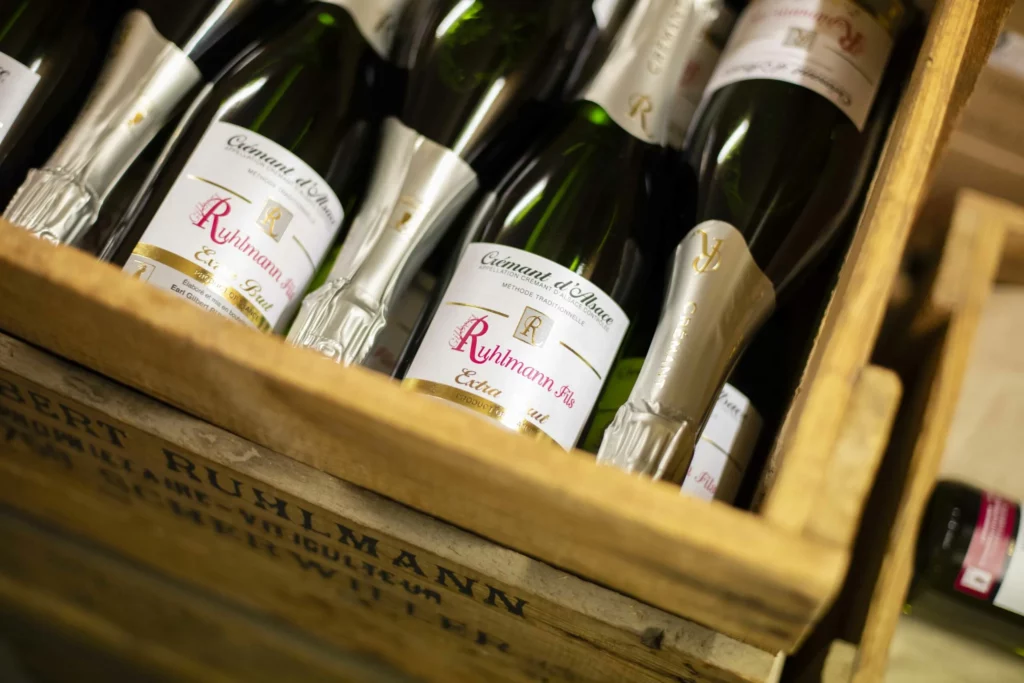
Crémant d’Alsace is the sparkling wine of Alsace. It has been a protected designation of origin (AOC) since 1976 and is made using the traditional method: its bubbles form in the bottle. At the estate, we have been making our own Crémant since 1984. Here is how it is made, which grape varieties go into it, what “brut” and “extra brut” mean, and how to serve it.
How is Crémant d’Alsace made?
The appellation sets strict rules, from the vine to the bottle. Here are the main steps, as we follow them in Scherwiller:
- Early hand harvesting: picking by hand is compulsory. The grapes travel in small crates holding 100 kg at most, so that they reach the press whole. We pick the grapes intended for crémant early, to preserve their natural acidity: this is what gives the wine its freshness.
- Whole-bunch pressing: the grapes are pressed very gently, without being destemmed. The appellation limits extraction to 100 litres of juice per 150 kg of grapes, so only the finest juice is kept.
- First fermentation: the juice ferments in stainless steel tanks and becomes still wine, the “base wine”.
- Bottling and second fermentation: from 1 December after the harvest, the wine is bottled with a little sugar and yeast. A slow second fermentation takes place in the sealed bottle: the carbon dioxide cannot escape and forms the bubbles.
- Ageing on the lees: the bottles rest on their side on their lees (the yeasts) for at least 9 months, and the crémant may only be sold 12 months after bottling. At our estate, we go much further: our crémants usually spend 18 months to 2 years on the lees, and our Vintage Crémant (Extra Brut) 36 months. This long rest gives a finer mousse and brioche notes.
- Riddling: the bottles are gradually tilted neck down and turned, so that the yeast deposit slides into the neck. For our Vintage Crémant, riddling is done by hand.
- Disgorging and dosage: the deposit is expelled, then the bottle is topped up with the “dosage liqueur”. Its sugar content decides the style: brut, extra brut… Our Vintage Crémant is disgorged “à la volée”, that is, by hand.
- Corking: the bottle is sealed with a natural cork. The name of the appellation must be printed on it, on the part that goes into the neck.
Which grape varieties go into Crémant d’Alsace?
Six grape varieties are allowed for white Crémant d’Alsace: Pinot Blanc, Auxerrois, Pinot Gris, Pinot Noir (pressed as a white wine), Riesling and Chardonnay. Crémant Rosé is made exclusively from Pinot Noir, the only red grape variety of Alsace.
At the estate, our Crémant d’Alsace Brut blends Pinots, Riesling and sometimes Chardonnay. Our Vintage Crémant is mainly Chardonnay. Our Crémant Rosé is 100% Pinot Noir, pressed directly to obtain a pale pink colour.
Brut, extra brut: what does the dosage mean?
After disgorging, each bottle receives a small dose of dosage liqueur. Its sugar content sets the term on the label, under European regulations:
| Term | Sugar per litre | On the palate |
|---|---|---|
| Brut nature | less than 3 g, no added sugar | Very dry, no dosage at all |
| Extra brut | 0 to 6 g | Very dry, pure and precise |
| Brut | less than 12 g | Dry and balanced: the most common style |
| Extra dry | 12 to 17 g | A hint of sweetness |
| Sec, demi-sec | 17 to 50 g | Sweeter and sweeter |
The less sugar, the more the wine shows its purity: this is why our Vintage Crémant, aged for a long time, is an extra brut. Our Crémant d’Alsace and our Crémant Rosé are bruts, the most versatile style, from the aperitif to dessert.
Brut, extra brut, rosé: our three crémants
| Wine | Grapes and ageing | Aromas | Food pairings | Ageing potential |
|---|---|---|---|---|
| Crémant d’Alsace Brut |
Pinots, Riesling, sometimes Chardonnay, 18 months to 2 years on the lees | White flowers, peach, brioche | Aperitif, seafood, braised ham, fruit desserts, fish choucroute | 2 to 3 years |
| Crémant Extra Brut (vintage) Extra brut |
Mainly Chardonnay, 36 months on the lees, hand riddling | Brioche, white flowers, toasty notes | Aperitif, lobster, langoustines, delicate fish, fish choucroute | 3 to 5 years |
| Crémant Rosé d’Alsace Brut |
100% Pinot Noir, 18 months to 2 years on the lees, salmon-pink colour | Raspberry, strawberry | Aperitif, seafood, smoked salmon, light desserts | 2 to 3 years |
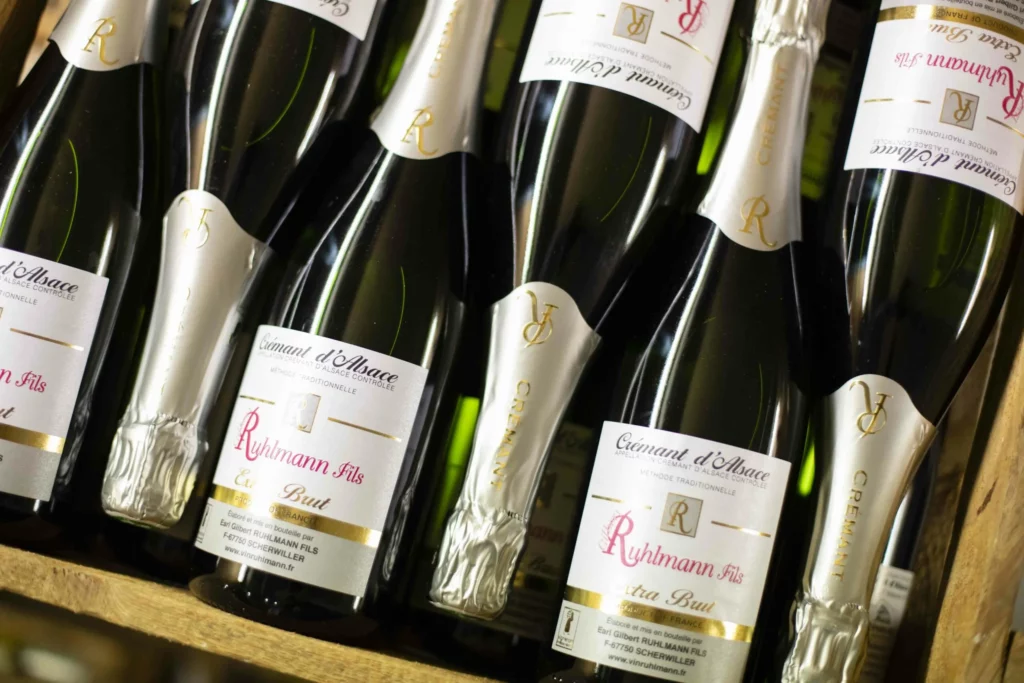
How to serve and store Crémant d’Alsace
- Temperature: between 5 and 7 °C. Put the bottle in the fridge a few hours beforehand, or for 20 to 30 minutes in a bucket of water and ice.
- Glass: choose a tulip-shaped white wine glass rather than a very narrow flute. The aromas come through better.
- Opening: hold the cork and gently turn the bottle, slightly tilted. The cork should come out without a pop, so the bubbles stay in the wine.
- Ageing: our crémants are ready to drink now. You can keep the Brut and the Rosé for 2 to 3 years, and the vintage Extra Brut for 3 to 5 years.
- Storage: bottles lying down, somewhere cool and dark. An opened bottle keeps until the next day in the fridge, closed with a sparkling wine stopper.
Come and taste our crémants
The easiest way to choose is still to taste. Come and discover them at the cellar in Scherwiller, open 7 days a week: let us know you are coming. You can also order them online on our Crémants page.
Frequently asked questions
Is Crémant d’Alsace an AOC?
Yes. Crémant d’Alsace has been a protected designation of origin (AOC) since 1976, with strict rules: hand harvesting, whole-bunch pressing, traditional method, at least 9 months on the lees and at least 12 months between bottling and sale. At our estate, our crémants usually spend 18 months to 2 years on the lees, and 36 months for the vintage Extra Brut.
What is the traditional method?
It is the method in which the second fermentation, the one that creates the bubbles, takes place directly in the bottle. The wine then rests on its lees before being disgorged, dosed and corked.
What is the difference between a brut and an extra brut crémant?
The dosage, that is, the sugar added after disgorging: less than 12 g per litre for a brut, 0 to 6 g for an extra brut. Extra brut is drier and more precise, while brut is rounder and suits any occasion.
At what temperature should Crémant d’Alsace be served?
Between 5 and 7 °C, to enjoy its freshness and the finesse of its bubbles.
How long can you keep Crémant d’Alsace?
Our crémants are ready to drink as soon as they are released. The Brut and the Rosé keep for 2 to 3 years, the vintage Extra Brut for 3 to 5 years.
What should you serve with Crémant d’Alsace?
As an aperitif of course, but also with a meal: seafood, lobster, smoked salmon, braised ham, fish choucroute or fruit desserts, depending on the wine.