
Riesling or Pinot Gris? They are two great Alsace whites, often side by side on the wine list, but they are not alike. Riesling is taut, lively and mineral, Pinot Gris is richer and rounder, with smoky notes. Here is how to tell them apart and which one to choose for your dish.
The difference at a glance
| Criterion | Riesling | Pinot Gris |
|---|---|---|
| Acidity | High | Medium |
| Main aromas | Lemon, grapefruit, white flowers, stone | Yellow fruit, smoke, undergrowth |
| Body | Vertical, taut | Rich, structured |
| Main style | Dry | Dry to off-dry |
| Ageing potential | Very high | High |
| Typical pairing | Oysters, choucroute | Roast poultry, mushrooms |
Riesling: freshness and tension
Riesling is the most widely planted grape variety in Alsace (around 3,500 hectares, nearly 23% of the vineyard). It is recognisable by its acidity: it is the most linear of the great Alsace whites. On the nose, citrus (lemon, grapefruit) and white flowers. On the palate, lively acidity and a mineral, saline finish.
At the table, its acidity cuts through fat and its minerality echoes the sea: seafood, fish, poultry in cream sauce, choucroute, goat’s cheese, and even spicy Asian cuisine.
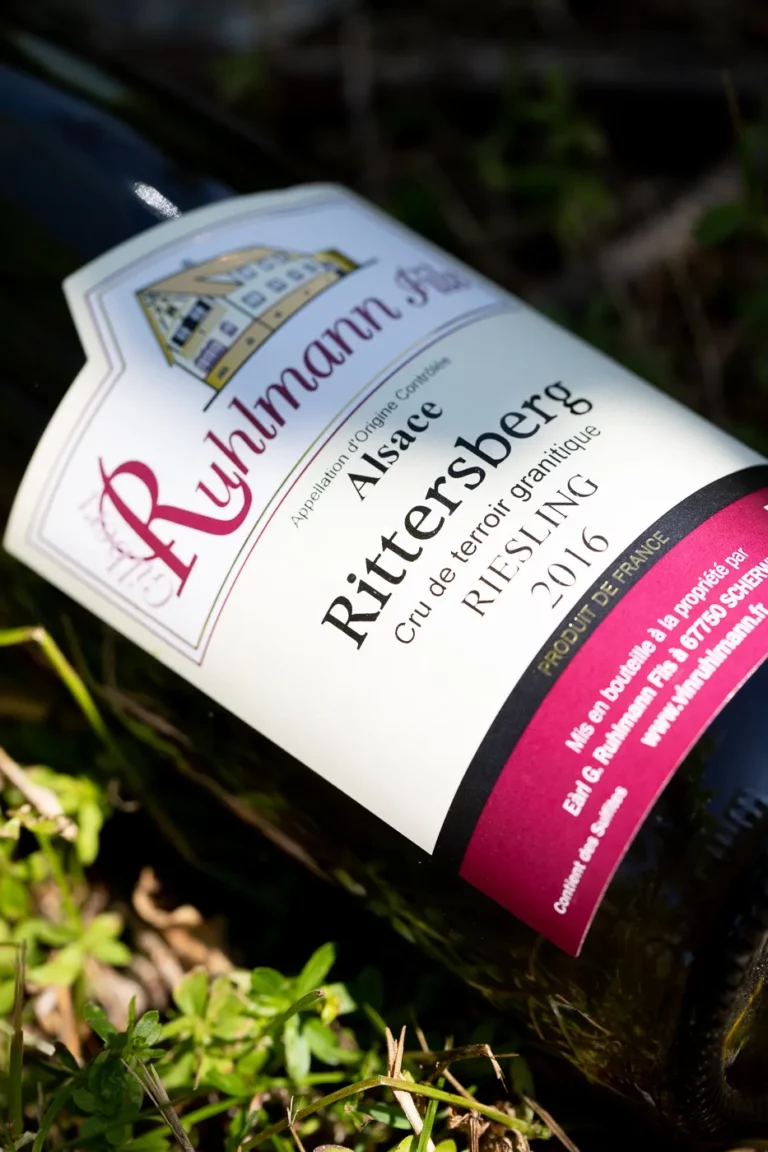
Our Rieslings: Riesling (dry, lemon, pepper and sage), Riesling Scherwiller (citrus and yellow fruit, our communal appellation), Rittersberg Riesling (granite, acacia blossom and mineral notes) and Riesling Vieilles Vignes (off-dry, vines over 50 years old).
Pinot Gris: roundness and smoky notes
Pinot Gris sits between Riesling and Gewurztraminer, with more richness and smoky notes. Its compact clusters of small purplish-pink berries are rich in sugar: the wine is round, full-bodied and long on the palate, with pear, peach and delicate smoky touches. It turns golden quickly, whereas Riesling stays pale and bright.
At the table, it goes with rich dishes: foie gras and sweet-and-savoury dishes, roast duck or duck breast, braised and slow-cooked meats, grilled or spiced fish, pan-fried scallops.
Our Pinots Gris: Pinot Gris (off-dry, pear, peach and smoky notes), Pinot Gris Ortenberg (a single vineyard on granite sands, to be served between 12 and 14 °C) and our Grand Cru Frankstein, an off-dry Pinot Gris from the granite slopes of Dambach-la-Ville.
Which one to choose for your dish?
| Dish | Our advice |
|---|---|
| Oysters, shellfish | Rittersberg Riesling |
| Grilled fish, sushi | Riesling Scherwiller |
| Choucroute, flammekueche | Riesling |
| Lobster, fish in sauce | Riesling Vieilles Vignes |
| Foie gras | Pinot Gris or Pinot Gris Ortenberg |
| Roast duck, duck breast, braised meats | Pinot Gris Ortenberg |
| Pan-fried scallops, prawns | Pinot Gris |
| Poultry, spicy cuisine, mature cheeses | Grand Cru Frankstein |
A simple rule: for a briny, tangy or fatty dish that needs cutting, choose Riesling, for a rich, sweet-and-savoury or slow-cooked dish, choose Pinot Gris.
Telling them apart blind
Three steps are enough: look for acidity on the finish (Riesling keeps it), look for citrus rather than yellow fruit, and look at the colour: Riesling stays pale and bright where Pinot Gris quickly turns golden.
Serving and ageing
- Riesling: between 8 and 10 °C. Ageing: 3 to 4 years for our Riesling, 3 to 5 years for the Riesling Scherwiller, the Rittersberg Riesling and the Riesling Vieilles Vignes.
- Pinot Gris: between 8 and 10 °C for the Pinot Gris and the Grand Cru Frankstein, 12 to 14 °C for the Ortenberg. Ageing: 3 to 4 years for the Pinot Gris, 4 to 6 years for the Ortenberg, 2 to 6 years for the Frankstein.
Frequently asked questions
What is the difference between Riesling and Pinot Gris?
Riesling is a taut white with high acidity and aromas of citrus and white flowers, most often dry. Pinot Gris is richer and more structured, with medium acidity and aromas of yellow fruit and smoke, and ranges from dry to off-dry.
Is Pinot Gris sweeter than Riesling?
Often, yes: Alsace Riesling is dry in the vast majority of cases, while Pinot Gris ranges from dry to off-dry. Our Pinots Gris range from off-dry to sweet.
Which one to serve with foie gras?
Pinot Gris, or a sweet Riesling (Vendanges Tardives). A dry Riesling is better suited to seafood, fish and choucroute.
To find out more: Riesling, the king of Alsace grape varieties? and Alsace Gewurztraminer, an emblematic wine!.